

Originally published July 31, 2022 · Last updated August 20, 2026
After helping thousands of travelers plan trips to Iceland, I can confidently say that renting a car is one of the topics people ask me about most. And honestly, I understand why. Between choosing a 2WD or 4×4, understanding insurance options, navigating F-roads, and keeping up with new rules like Iceland’s road tax, there is a lot to consider.
That’s why I created this guide. It provides you with information I wish every traveler knew before picking up their rental car. I’ve combined my experience living in Iceland with the questions I hear most often so you can avoid costly mistakes, drive safely, and make the most of your time exploring this incredible country.
Ready to rent a car in Iceland?
I personally use Go Car Rental Iceland when traveling around Iceland, and recommend them to my readers because they have great customer service and a large variety of cars.
All Things Iceland readers get 7% off + free 4G Wi-Fi with their rental. The 7% discount is automatically applied through my discount link after you select your rental car dates. Choose 4G Wi-Fi in the extras section for no additional cost.
Affiliate disclosure: There are affiliate links in this article. If you book through my links, I earn a small commission at no extra cost to you. Your support helps fund All Things Iceland and allows me to continue creating free Iceland travel resources like this guide. Thank you for supporting my work! 🙏🏾
Iceland Rental Car Guide Table of Contents
- Is it Worth it to Rent a Car in Iceland?
- Common Rental Car Mistakes in Iceland made by Tourists
- Go Car Rental Iceland
- When to Book Your Rental Car
- Price comparison between seasons when renting a car in Iceland
- Iceland’s New Road Tax – added in 2026
- What is Needed to Rent a Car in Iceland
- 2WD vs 4×4 in Iceland- The type of car that is right for your adventure
- Insurance for your rental car
- What Rental Car Insurance in Iceland Do I Actually Need?
- Mileage limits
- Picking Up Your Rental Car
- Driving Around Iceland
- What to check before driving around the country
- Navigating Iceland by car
- How Roundabouts work in Iceland – Must Read!
- Speed Limits in Iceland
- Speed Traps on the road
- What Happens When you Get a Speeding Ticket in Iceland
- Road Signs that are unique in Iceland
- Paying for Parking
- Tolls
- Roadside Assistance
- Fueling Up your rental car
- Summer vs Winter Driving
- F-Roads vs Gravel Roads: What’s the Difference?
- Very Important to keep in Mind when driving in Iceland
- Returning Your Rental Car
- Ways to Save Money When Renting a Car in Iceland
1. Is it worth it to rent a car in Iceland?
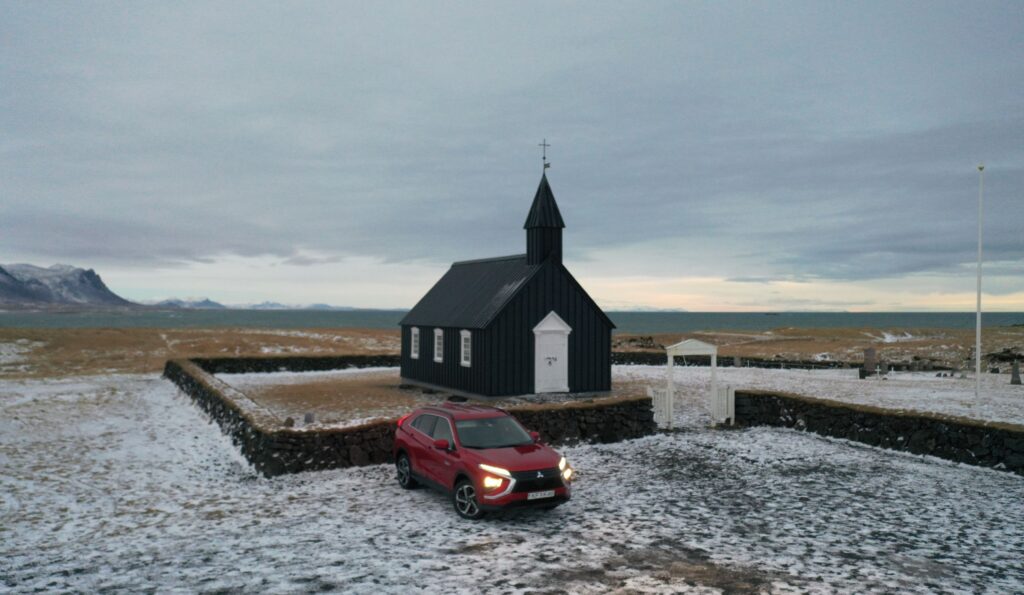
As a person that loves to explore and do things at my own pace, renting a car is the best option for me. If that same feeling resonates with you, then you’ve come to the right post. I’ve broken this post into different sections. First, I will go over when you should consider booking your car, then I talk about what to know when picking up your vehicle.
Next, is what is important for you to keep in mind while driving in Iceland. After that is what to do when returning your car, and lastly is ways in which you can save money when renting a car in Iceland.
Of course, I will also have my Icelandic word of the episode/post and the random fact about Iceland sections at the very end.
2. Common Rental Car Mistakes Tourists Make in Iceland
I’ve noticed that the same rental car mistakes come up again and again. In fact, if you spend just a few minutes browsing Iceland travel forums or Reddit threads, you’ll quickly see that many visitors run into the exact same problems.
The good news is that most of these mistakes are completely avoidable with a little preparation. I also go into each of these more in depth in this guide.
Booking a Vehicle That’s Too Small
It’s tempting to choose the smallest and cheapest vehicle available, especially if you’re trying to save money. However, many travelers underestimate how much luggage they have or how much time they’ll spend in the car.
A compact vehicle might look perfect online, but after squeezing in four adults, multiple suitcases, backpacks, and winter clothing, many visitors wish they had upgraded to something larger. If you’re traveling with several people or carrying a lot of gear, it’s often worth choosing a vehicle with extra space and comfort.
Skipping Gravel Protection
This is probably one of the most common regrets I see from travelers after their trip.
Many visitors assume that because they plan to stay on paved roads, they won’t encounter gravel. The reality is that gravel parking lots, pull-offs, and side roads are incredibly common throughout Iceland. Even a small rock kicked up by another vehicle can crack a windshield or chip your paint.
The money saved by declining gravel protection can quickly disappear if damage occurs.
Ignoring Wind Warnings
Visitors often focus on snow, rain, or ice when checking the weather, but Iceland’s wind is frequently the bigger concern.
Strong gusts can make driving difficult, especially for larger vehicles, camper vans, and SUVs. In extreme cases, roads may become hazardous or temporarily closed. Wind can also damage vehicle doors if they are not held securely when exiting the car.
If the forecast is calling for strong winds, take it seriously. Icelanders certainly do.
Taking a 2WD Vehicle on an F-Road
Every year, travelers end up stranded, fined, or facing expensive repair bills because they drive a two-wheel-drive vehicle onto an F-road.
As mentioned earlier in this guide, F-roads are mountain roads that require a 4×4 vehicle by law. Rental agreements specifically prohibit driving non-approved vehicles on these roads, and insurance coverage may be voided if you do.
If your itinerary includes Highland destinations such as Landmannalaugar, Askja, or Þórsmörk, make sure your vehicle is approved for the roads you’ll be driving.
Not Understanding Iceland’s Roundabout Rules
Roundabouts are one of the most common driving situations that confuse visitors.
Many countries follow different roundabout rules, and travelers often assume Iceland works the same way as their home country. Iceland’s two-lane roundabouts have a unique rule where the vehicle in the inner lane generally has priority when exiting. Visitors unfamiliar with this system can create dangerous situations by changing lanes unexpectedly.
Before picking up your rental car, take a few minutes to learn how Icelandic roundabouts work. It can save a lot of stress once you’re on the road.
Choosing the Cheapest Rental Company Without Research
Everyone loves saving money, but choosing a rental company based solely on the lowest price can sometimes create bigger headaches later.
Before booking, read recent reviews, understand what insurance is included, check the company’s reputation for customer service, and review how they handle fees such as the new road tax. A slightly more expensive rental can often provide significantly better value if it includes important coverage, transparent pricing, and reliable support.
Not Checking Road Conditions Daily
One of the biggest mistakes visitors make is assuming road conditions will remain the same throughout their trip.
Weather and road conditions can change rapidly in Iceland, especially outside of summer. A route that was completely clear in the morning may become difficult or even closed later in the day due to wind, snow, flooding, or other conditions.
I recommend checking road conditions every morning before heading out. It only takes a few minutes and can help you avoid delays, dangerous situations, or unexpected route changes.
The Bottom Line
Most rental car problems in Iceland don’t happen because travelers are reckless. They happen because visitors simply don’t know what to expect. By choosing the right vehicle, understanding insurance options, respecting weather warnings, and checking road conditions regularly, you’ll avoid many of the mistakes that show up repeatedly.

3. Go Car Rental Iceland – My Preferred Local Icelandic Rental Company
I‘ve personally used Go Car Rental Iceland and I highly recommend them. They have transparent pricing, a great selection of vehicles, and great customer service.
Get 7% off Your Entire Car Rental & Free 4G Wifi
With my discount link for Go Car Rental, you’ll save 7% and get free 4G WiFi with your rental. After you click the link, enter your dates for the rental and the 7% discount will be automatically applied.
When you get to the extras section, select 4G WiFi. You’ll see the price stays the same, even though it has been added.
I‘ll be getting into the cost of car rentals in Iceland in this article, but be sure to keep in that discount link in mind.
4. When to Book a Rental Car in Iceland
When to book your rental car in Iceland will, of course, come down to when you plan to visit. If you haven’t already booked your trip, then here is what I advise for you to think about. The peak season in Iceland is the summer (June, July, and August).
Because renting a vehicle allows you to have more freedom, many travelers choose this option, which means that the closer you get to the peak season, your choices of rental cars diminish quite a bit. Additionally, the cost of rental cars in Iceland is much higher during this time.
This is not meant to discourage you from coming to Iceland during summer, but I think it’s important for you to know. From September to May, there are usually more rental cars available, and they are not as expensive.
If you plan to rent a car during the summer here, I recommend booking your car as soon as you have that plane ticket. Some people get their tickets as early as six months ahead of time, but I find that most are booking within a few months.
Price comparison between renting a car in Iceland the high season vs the low season
To give you an idea of the difference in cost between summer and the off season, like fall /winter. I went to Go Car Rental Iceland’s website to see what it costs to rent a VW Polo Automatic
From July 27th to July 30th, it’s $556
From October 11th-14th, it’s about $189 for three days.

What Is Iceland's New Road Tax for Rental Cars? (New in 2026)
If you’ve been researching car rentals in Iceland recently, you’ve probably come across discussions about the country’s new road tax. This is one of the biggest changes affecting travelers in 2026, and understandably, it has created some confusion.
Starting on January 1, 2026, Iceland introduced a new kilometer-based road tax that applies to all vehicles, including rental cars. The fee is designed to help fund road maintenance and infrastructure and replaced a portion of the fuel taxes that drivers previously paid at the gas pump. The important thing to understand is that this is a government-mandated fee, not an extra charge invented by rental car companies.
For standard passenger vehicles and SUVs under 3.5 tons, the government rate is 6.95 ISK per kilometer driven. However, rental companies are allowed to collect the fee in different ways. Some companies charge the exact amount based on the number of kilometers you drive during your trip. Others simplify the process by charging a fixed daily fee that is calculated using the average distance traveled by rental customers in Iceland. As a result, you may see the road tax listed differently depending on which rental company you choose.
To give you a better idea of what this means in practice, let’s look at some common Iceland itineraries. If you stay mostly in Reykjavík and make a few short day trips, you might drive around 200 kilometers during your trip. At 6.95 ISK per kilometer, the road tax would be approximately 1,390 ISK. A popular Golden Circle and South Coast itinerary often covers around 700 kilometers, resulting in a road tax of roughly 4,865 ISK. Travelers completing the full Ring Road can easily drive 1,500 kilometers or more, bringing the road tax to approximately 10,425 ISK. These examples assume a company that charges based on actual distance driven rather than a flat daily fee.
The good news is that the new road tax is not necessarily an additional travel expense. Because Iceland simultaneously reduced traditional fuel taxes, fuel prices have decreased compared to previous years. In many cases, the cost has simply shifted from the gas pump to a more transparent pay-for-what-you-use system.
When comparing rental companies, make sure you check how the road tax is handled before booking. Some companies include a fixed daily road tax fee in their pricing (like Go Car Rental Iceland), while others calculate the final amount based on your actual mileage. Knowing how the fee is applied can help you avoid surprises and accurately compare rental costs between companies.
What is needed to rent a car in Iceland?
Thankfully, it’s simple to rent a car here. You can easily do it online. You only need a valid driver’s license, a credit card or debit card and meet the age criteria.
You must be at least 20 years to rent a car in Iceland. Well, to get any 2-wheel drive. If you want to rent a 4-wheel drive vehicle or a van, then you must be 23 years of age or older.
What type of license is accepted in Iceland to rent a car?
Many rental companies have a similar policy, but I’ll just reference the one from Go Car Rental as an example. In essence, if your valid driver’s license is written in English or western alphabetical letters, you’re fine.
If a translated copy of the license in English cannot be provided, then you need an international driver’s license.
2WD vs 4x4 in Iceland- The type of car that is right for your adventure
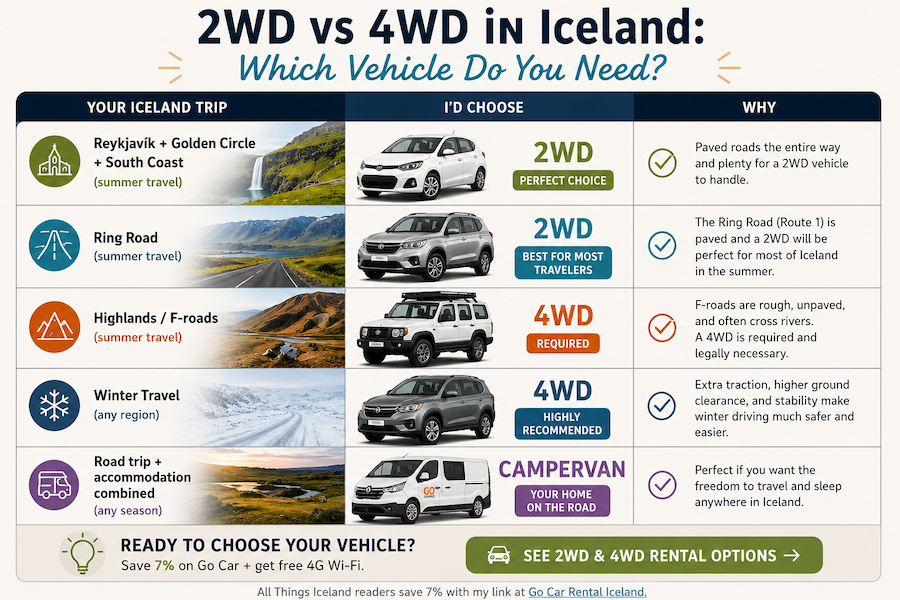
The types of rental cars you will typically find in Iceland are 2WD, 4WD, and camper vans. While there are a decent amount of manual car, there are usually of plenty of automatic cars for those that need that option.
The great news is that if you plan to just drive around Iceland’s ring road from May to early October, and go to some of the most popular attractions here, such as the Golden Circle, Diamond Circle, and South Coast, then you only need a 2WD.
4WD is great for people that plan to go into the highlands (only open in summer), which require you to drive on F-roads (these are mountain roads). Some people also like to rent 4WD during the winter (including me!), but 2WD cars do just fine here during that season. With that said, a 4×4 or 4wd provides more clearance during winter and control of the car, so I always recommend those in my private trip consultations.
One important thing to know is that many rental car companies in Iceland put studded tires on their cars during the winter season. Those tires make sure that the car has better traction while driving and will for sure come in handy when you drive on country roads. Not all of them do this, so make sure to check out if the company you plan to rent with is using studded tires before making your decision.
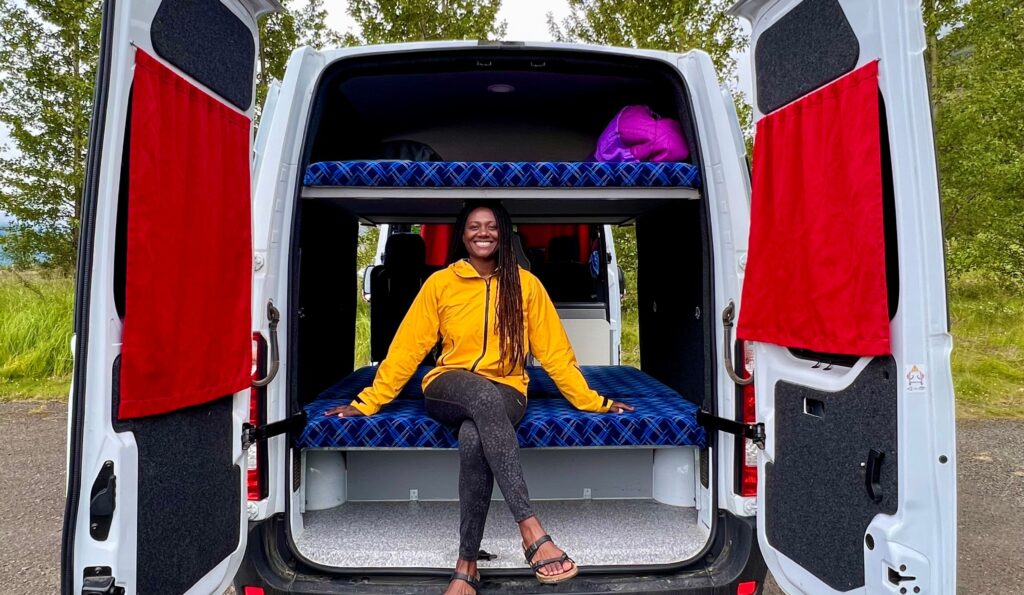
Renting a Campervan in Iceland
A camper van is a great budget friendly option. Go Car Rental Iceland has a sister company called Go Campers. My discount for Go Campers is 7% and also comes with a free added sleeping bag.
When you click on my discount link, enter your dates for renting the camper van and the 7% will automatically be applied.
Choose a sleeping bag under the “extras” section, and the total price won’t increase.
I have traveled via camper van around Iceland many times and loved it, but I’ll go into that in another episode.
Insurance for your rental car
One of the questions I probably get asked the most about renting a car in Iceland is if the additional insurance is necessary. Personally, I always opt for it because I know that Icelandic weather can result in damage to the car that is out of the renter’s control. An example of this is sand and ash protection.
Icelandic Weather is Unpredicatable
Iceland is notorious for being windy. During a windstorm, or just a very windy day, it’s possible for the wind to pick up sand and ash that scraps the car. This can result in the paint of the car coming off in places. In extremely windy conditions, windows and lights can be broken.
Windstorms can happen any time of the year. While I don’t know the likelihood of it happening during your trip, I will just say that my personal preference to have everything covered. You can use this information as a way of knowing what’s possible and just decide for yourself if you want to have the additional insurance or not.
It varies among rental car companies as to what insurance is covered. For instance, Go Car Rental Iceland includes CDW (Collision Damage Waiver), SCDW (Super Collision Damage Waiver) and Gravel Protection. Many rental car companies I know don’t include gravel protection, which would cover you if there is a crack in the windshield and headlights.
What Rental Car Insurance in Iceland Do I Actually Need?
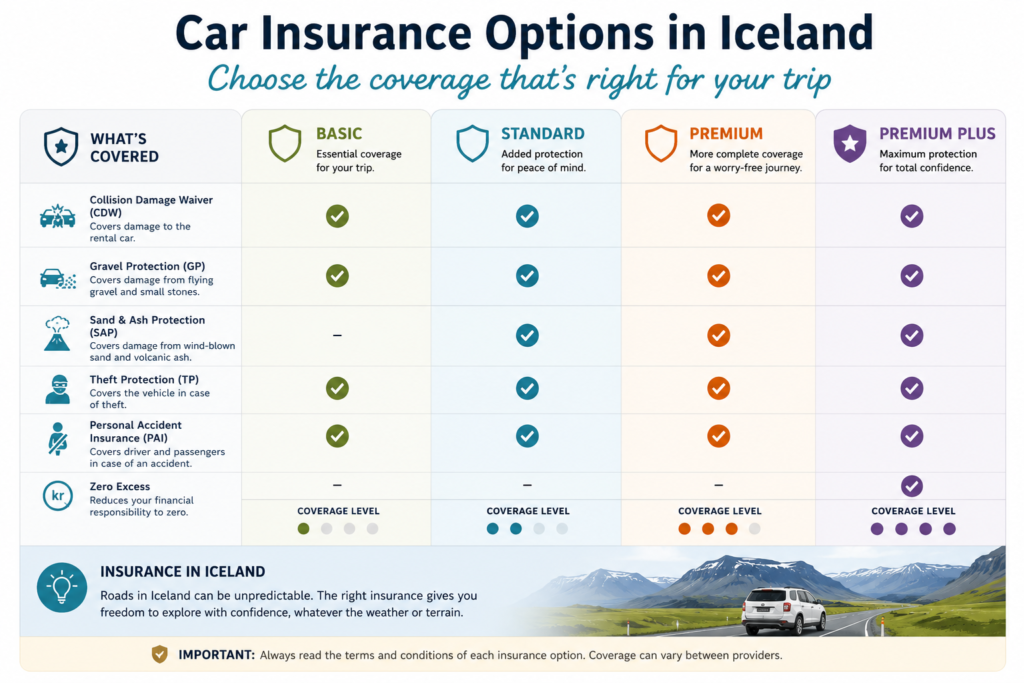
The short answer is that Iceland’s driving conditions are very different from what many travelers are used to. While you might feel comfortable declining extra coverage when renting a car in other countries, Iceland is one of the few places where additional protection is often worth considering.
The most common types of damage reported by travelers aren’t usually major accidents. Instead, they’re things like chipped windshields from flying gravel, paint damage caused by loose stones, doors being caught by strong wind gusts, and damage from sand and ash storms in certain parts of the country. These are exactly the types of incidents that catch visitors by surprise because they can happen even when you’re driving carefully.
One of the biggest mistakes I see travelers make is assuming that their credit card’s rental car insurance provides complete coverage. While some credit cards offer valuable rental car protection, many do not cover gravel damage, sand and ash damage, tire damage, undercarriage damage, or damage caused by Iceland’s unique weather conditions. Before relying solely on your credit card coverage, carefully review the policy details and confirm exactly what is and isn’t included.
Gravel Protection
If you’re planning to drive anywhere beyond Reykjavík, gravel protection is one of the coverages I recommend considering most seriously.
Even if your itinerary stays on paved roads, loose gravel is common in parking lots, pull-offs, and road shoulders throughout Iceland. It’s not unusual for passing vehicles to kick up stones that chip a windshield or damage paintwork. Many travelers who skip gravel protection end up wishing they hadn’t after receiving an unexpected repair bill.
Sand and Ash Protection
Sand and ash protection is unique to Iceland and often confuses visitors.
In certain parts of the country, particularly along the South Coast and in areas near volcanic landscapes, strong winds can pick up sand and volcanic ash and essentially sandblast a vehicle. The damage can be extensive and expensive, affecting paint, windows, headlights, and exterior surfaces.
While major sand and ash storms don’t happen every day, the potential repair costs can be significant enough that many travelers prefer the peace of mind this coverage provides.
Wind Damage Coverage
If you’ve spent any time researching Iceland travel, you’ve probably heard people talk about the wind.
What many visitors don’t realize is that strong gusts can damage a car even when it’s parked. A sudden gust can catch a door and force it open beyond its normal range, damaging hinges or the door itself. This is one of the most common types of rental car damage in Iceland.
The best protection is always prevention—hold your door firmly when exiting the vehicle—but insurance can help reduce the financial impact if an accident happens.
My Insurance Recommendations
The right insurance depends largely on where you’re traveling and the time of year.
If you’re staying mostly in Reykjavík and taking only short day trips on well-maintained roads, I generally recommend at least basic coverage combined with gravel protection.
For travelers driving the Ring Road, exploring multiple regions, or spending a week or more on the road, full coverage is often worth the additional cost. It can provide peace of mind when dealing with changing weather, gravel parking areas, and longer driving distances.
If you’re planning to drive in the Highlands, travel on F-roads, or visit remote areas where road conditions can be rougher, I strongly recommend choosing the maximum coverage package offered by your rental company.
At the end of the day, insurance is about balancing risk and budget. You may never need to use it. However, after living in Iceland for years and hearing countless traveler stories, I can tell you that the people who regret purchasing extra coverage are far fewer than the people who regret declining it.
A Simple Way to Save on Rental Car Costs
I completely understand that adding extra insurance can increase the overall cost of your rental. While I generally recommend choosing enough coverage to give yourself peace of mind, there are ways to offset some of those costs.
One option is to use my discount partnership with Go Car Rental Iceland and Go Campers. Through my link, you’ll automatically receive a 7% discount on your rental.
For regular rental cars through Go Car Rental, you’ll also receive free 4G WiFi. For camper van rentals through Go Campers, you’ll receive a free sleeping bag.
You can access both discounts here:
Many travelers use the savings from the discount to help offset the cost of additional insurance coverage, making it easier to protect themselves without significantly increasing their overall travel budget.
Mileage limits on Rental Cars in Iceland
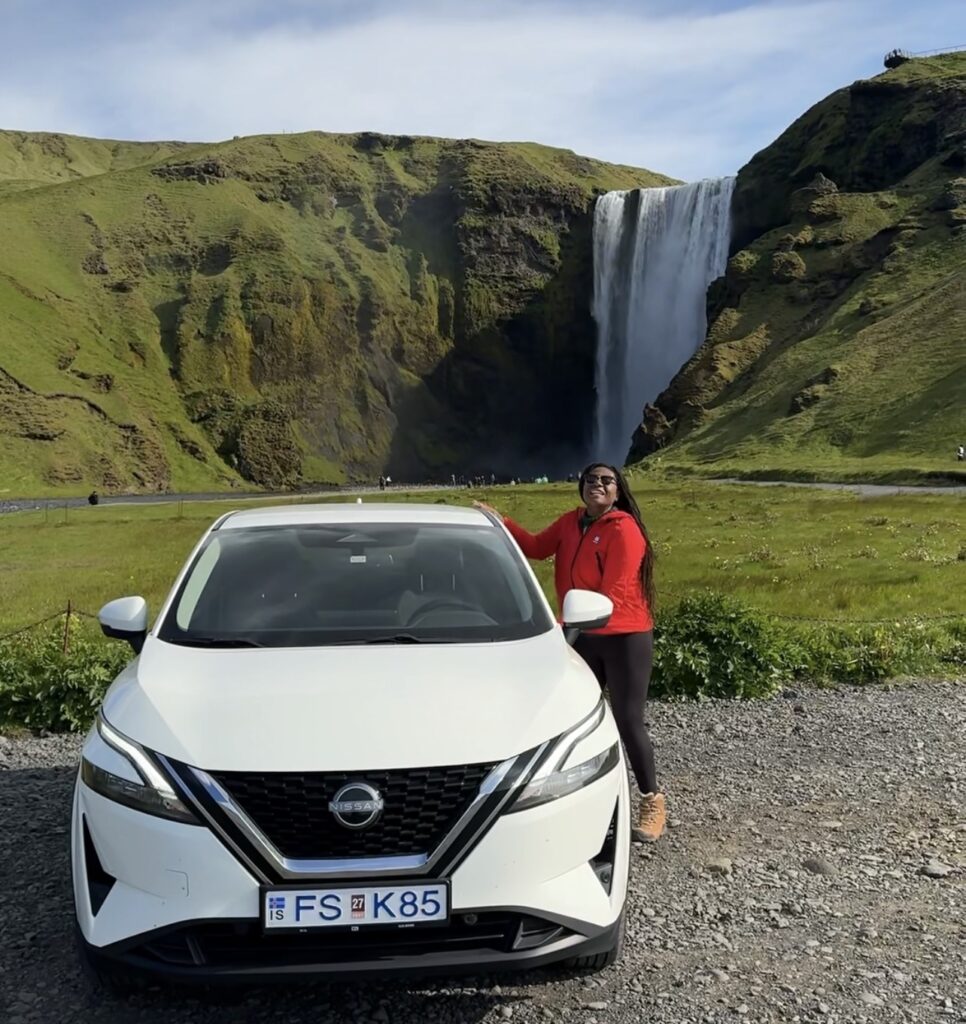
The fine print is worth reading regarding this topic because mileage limits can become costly, if you aren’t aware of them and plan to do a lot of driving.
I highly recommend going with a company that has unlimited mileage on your vehicle. For some companies, the unlimited mileage is for short-term rentals, which are rentals that are for less than a month.
Most travelers are visiting for up to two weeks, so that shouldn’t pose an issue. My only advice is to double check that mileage is unlimited so you can freely drive to as many places as you want without hesitation.
5. Picking Up Your Rental Car
Now that you have an overview of what to know and look for when booking your car, we can move on to picking up your rental in Iceland.
Pick up from Keflavik vs in Reykjavík
Keflavík airport is where most people flying internationally land in Iceland. Many people opt for picking their car up there but some companies, like Go Car Rental Iceland, have shuttles to and from Reykjavík for free, so you can pick up your car there.
It honestly just depends on where the car rental company is located and their policies. Again, reading thoroughly through the FAQs on a rental car site and the fine print will keep you informed as to what is included or is an additional cost.
Inspecting Your Vehicle When You Pick It Up
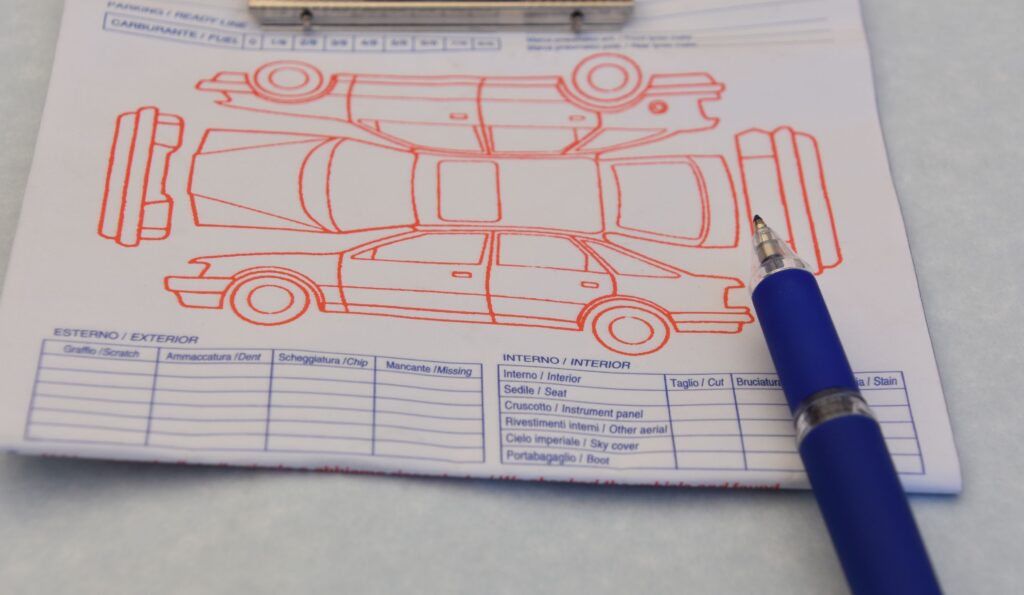
One of the most important parts about renting a car anywhere is to be meticulous about inspecting it, and writing down, as well as taking pictures, of any damages and scratches the car has before leaving the lot.
While I have not experienced any shady behavior with a car rental in Iceland, I have encountered renting a car that had different controls and settings to make it operate.
Some European models have functions that people from the US or other regions might not be familiar with. I highly recommend testing out how to turn the car on and off, the windshield wipers, turn signals, how to change the settings for the lights and so on.
Be Meticulous When Inspecting a Rental Car in Iceland
It’s encouraged to take photos and videos of the car, in addition to marking off any damages you see on the paper given to you by the car rental office.
Also, make sure to check if the car has any warnings popping up, such as an engine light or anything like that. It is easy to miss these things, especially if you are on that red eye flight 6 or 7 in the morning.
Lastly, check the tires of the car to ensure that are in good condition. You can use a penny, if you are from the US, a 20 pence coin, if you are from the UK or some equivalent to check the tread. Here is where you can find information that describes this type of test.
In Iceland, it can be rainy, snowy, and icy on roads, so good tread is a must. Also, there are some gravel roads that are not mountain roads, which can be a little slippery when wet or have loose rocks, so you will need good tires to safely drive there.
6. Driving Around Iceland
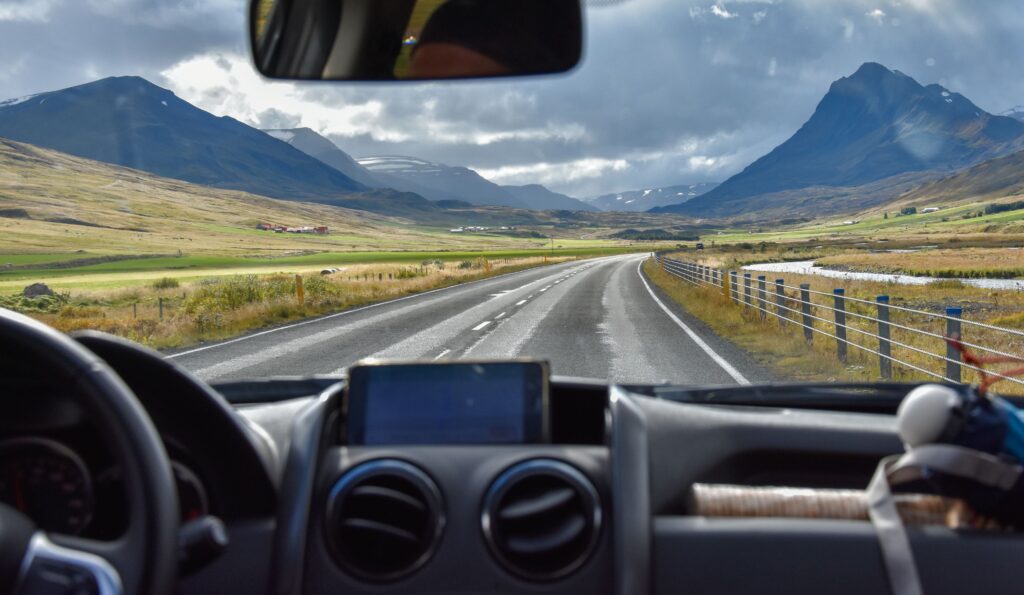
Thankfully, driving around Iceland is simple and easy. If you’re from a place where you drive on the right side of the road, you’ll be happy to know that Iceland does the same.
There is one road called road 1 that goes around the whole country. Many of the most popular attractions are just a turn off of this road. Nevertheless, having some type of navigation system is highly recommended.
Some people opt to download Iceland on Google Maps, so they can navigate without needing the internet. I do think that is a good option. At the same time, I like having phone service, or at least WIFI so I can look things up, check social media and so on.
Before Heading Out on Your Adventure in a Rental Car in Iceland
Always make sure to check the conditions of the road and weather before heading out on your trip. I recommend safetravel.is for weather warnings and road.is for road closures.
The worst thing is to head out not knowing the conditions and running into a severe storm, or a closed road that you could have known about beforehand.
Navigating Iceland by Car: Choosing GPS or WIFI for Your Rental Car
Most rental car companies give you the option of purchasing GPS or WIFI. I prefer WIFI because you can then use apps like Google Maps to navigate and have access to other things on your devices.
Another option is to check if the phone service you have in your home country, or wherever you have a phone service provider, has an inexpensive international plan. If that is not available or is too expensive, you can go the route of buying a SIM card in Iceland.
I’ll have links to phone companies in Iceland in the shownotes, so you can look further into the cost, if you are considering that option.
But just to give an example of a package (not sponsored), the phone company Síminn offers 5GB of data, 50 minutes of calling and 50 text messages in Iceland, Europe, the USA and other countries they have listed on the site for 2.900 ISK, which is abouy $21. That is for 30 days of service.
Good to know: If you rent through my Go Car Rental Iceland link, 4G Wi-Fi is included for free. Just select it under Extras when booking and the price won't increase.
How Roundabouts in Iceland Work - Very Important to Understand!
If you’re planning to drive in Iceland, understanding how roundabouts work is one of the most important things you can learn before getting behind the wheel.
Iceland has many roundabouts, particularly in and around Reykjavík, and while they may look familiar, the rules are slightly different from what many visitors are used to in their home countries. In fact, confusion about Icelandic roundabouts is one of the most common driving topics discussed in travel forums and Facebook groups.
The good news is that once you understand the basic rule, navigating them becomes much easier.
The Most Important Rule: The Inside Lane Has Priority
In Iceland’s two-lane roundabouts, vehicles in the inside lane (the left lane) have priority when exiting the roundabout.
This is often the opposite of what visitors expect.
If you are driving in the outside lane (the right lane), you should generally be preparing to exit at the next available exit. Drivers in the inside lane may continue around the roundabout or move toward an exit, and vehicles in the outside lane must yield accordingly.
Because of this rule, it’s important to pay attention to lane choice before entering the roundabout.
The Most Common Tourist Mistake in Roundabouts in Iceland
The mistake I see visitors make most often is entering the outside lane and then attempting to continue around the roundabout for multiple exits.
Many travelers assume the outside lane can be used to circle around the roundabout indefinitely, as is common in some other countries. However, in Iceland, the outside lane is primarily intended for vehicles exiting soon.
This creates confusion when a driver in the outside lane attempts to continue around while a vehicle in the inside lane is preparing to exit. Both drivers may believe they have the right of way, leading to sudden braking, hesitation, or near misses.
If you’re taking one of the first exits, use the outside lane. If you’re continuing farther around the roundabout, the inside lane is usually the better choice.
A Simple Way to Remember It
Think of the outside lane as the “exit lane” and the inside lane as the “travel lane.”
If you’re only going a short distance around the roundabout, enter the outside lane and prepare to exit.
If you’re continuing farther around the roundabout, enter the inside lane and then move toward your exit when appropriate.
Also, please NEVER change lanes in a roundabout! Doing so can lead to a serious accident.
While this is a simplification, it helps many visitors understand the basic flow of Icelandic roundabouts and avoid the most common mistakes.
Speed Limits in Iceland
If not posted, then the general speed limit for cars in Iceland is 50 km/h, which is about 31 mph, in urban areas. If a place is scarcely populated, it‘s common to see 70 km/h (about 43 mph).
Some highways and gravel roads are 80 km/h (50 mph) and many country roads, meaning the roads outside of the urban areas, are 90 km/h (about 55 mph) on asphalt roads. In some residental areas, the speed is 30 km/h or 19 mph.
Depending on where you are coming from, these speed limits might sound slow. Honestly, they are quite slow, especially when you are out on the open road and there are hardly any other cars around.
While it might be tempting to go much faster, the speeding tickets here are a big incentive to not go faster.
Speed Traps & Speeding Ticket Cost if Caught
There are two types of speed traps in Iceland. The first is the old-fashioned way in which a police officer is parked with a speed reader somewhere. Their placement can be obvious sometimes but there are other times when they are hidden.
The second type of speed trap is by camera. There are speed cameras placed at certain points in urban areas, like Reykjavík, and along the road out in the countryside. Unlike the first kind of speed trap, you are warned with a sign that a speed camera is coming up.
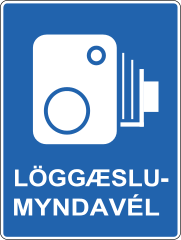
A speeding ticket can range from 30.000 ISK to 150.000 ISK ($220 – $1,101) but that depends on how much over the speed limit you are. The speeding fines are high on purpose because the police want discourage people from going too fast.
What Happens if You Get a Speeding Ticket in Iceland?
If you caught by a police officer, you could pay on the spot and get a discount. I´ve read that it is 25%. Another option is to pay later but then you won’t get a discount.
If you are caught by a speed camera and get the ticket in the mail, you are normally given a certain time to pay the ticket with a discount.
When a person does not pay the ticket on their rental car, the rental car company will normally pay it and charge you a surcharge for them having to take on the responsibility of paying it. Basically, you end up paying the fine and an additional charge.
Lastly, if feel that there was an error with speed camera, you can dispute the ticket, but I don’t know the likelihood of that working out in your favor.
Road Signs in Iceland
- Start of a gravel road
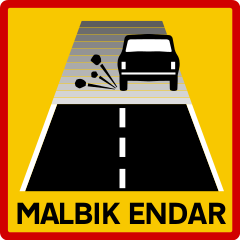
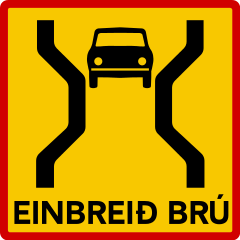
2. Single Lane Bridge
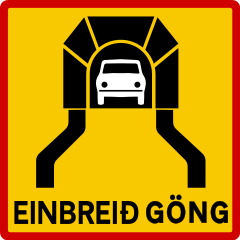
3. Single Lane Tunnel
4. Blind Hill

5. F-road: only 4×4 cars on these difficult roads

6. Roundabout up ahead

You can see all of the road signs in Iceland here.
Where You Have to Pay for Parking Iceland
There are some places where paying for parking is required in Iceland, so it’s good for you to keep that mind because parking ticket fines are common in those areas.
In Reykjavik, there are certain streets in the downtown area where it is required for you to pay to park. It’s normally from Monday to Friday in between 9:00 AM – 6:00 PM, and on Saturday from 10:00 AM – 6:00 PM. No parking fees on Sundays.
There are 4 parking zones and they are labeled P1, P2, P3, and P4, so keep a lookout for those signs when trying to find a parking spot.
Costs for Parking in Different Zones in Reykjavík
In a P1 zone, the price is 385ISK ($3) per hour.
In a P2 zone, the price is 200ISK ($1.56) per hour.
In a P3 zone, the price is 200ISK ($1.56) for the first two hours, then it’s 55ISK ($0.4) per hour.
In a P4 zone, the price is 200ISK ($1.56) per hour.
While there are physical parking meters that you can use to pay on the streets of Reykjavik, I suggest using an app. It is easier, faster, and sometimes the parking meters don’t work. The two apps I’m aware of are EasyPark and Parka.is.
Parka.is is also used at Vatnajökull National Park and for parking in Akureyri. In other places where you have to pay for parking, there is a machine where you use your card to pay and get a physical receipt.
Tolls to Pay When Driving in Iceland
Luckily, there is only one toll to pay here and that is for a tunnel in north Iceland. The tunnel is called Vaðlaheiðargöng and you can pre-pay the toll. Cars under 3.5 tons are 1.500 ISK per trip.
If you opt to pay 24-hours before the trip or 24-hours after you have gone through. If you drive through without paying the toll, a bill is sent to the registered owner of the vehicle with an additional fee for collection.
Conveniently, there is an app for paying the toll and you can find it here.
Roadside Assistance for your Rental Car
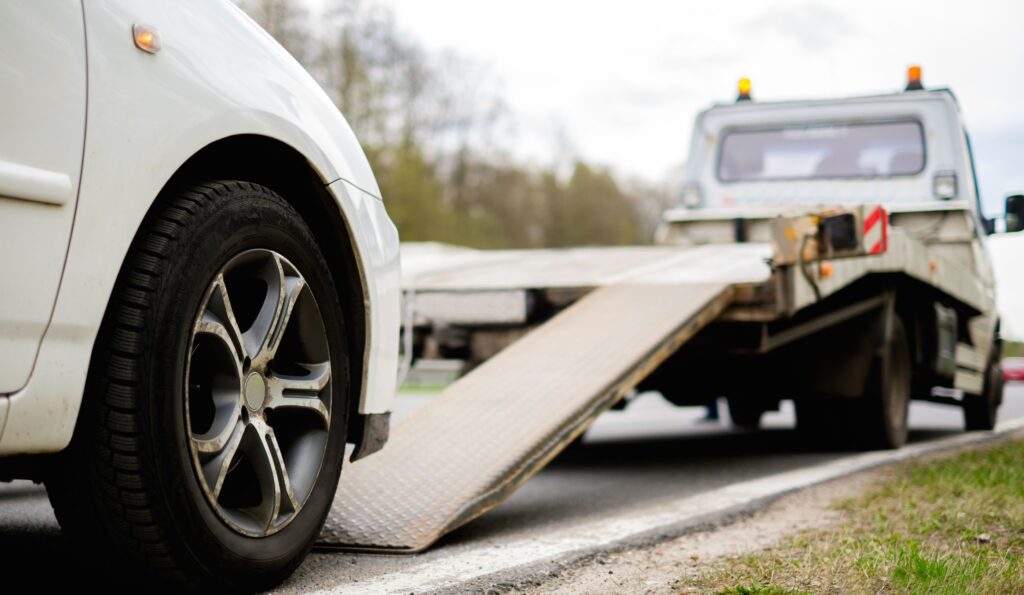
The level of roadside assistance for your rental car varies by company in Iceland. For instance, Go Car Rental Iceland has 24/7 roadside assistance.
If you contact them between 8:00 AM and 7:00 PM, then you get someone at the desk of the company to guide you. After those hours is a different number but you will get assistance either way.
While some of us might be used to a person coming to fix our tire, if it were to puncture, that is quite an expensive cost for the renter.
You might end up paying close to 100.000 ISK or more than $700. Most rental car companies here guide you through changing the tire, if you are not aware of how to do it yourself.
In the case of an emergency, please call 112, Iceland’s emergency phone line.
Fuel Stations in Iceland For Your Rental Car
There are many gas stations around the country, so you won‘t have a problem filling up on either gas (green handle), which is called bensín in Icelandic, or diesel (black handle) as you travel around.
When I am out in the countryside, I don‘t like to let my tank get below a quarter because the next gas station might be a fair distance away.
If you plan to drive into the highlands, definitely make sure to have a full tank because there aren‘t places for you to fill up.
Gas Prices in Iceland
As of this recording, the lowest gas price I found was 221 ISK per liter, which is $1.82 per liter.
In US gallons, that is $6.89 per gallon. This price can go up or down depending on exchange rates and the cost of fuel. This was specifically calculated for gas prices but the price of diesel is similar.
Winter vs Summer Driving in Iceland
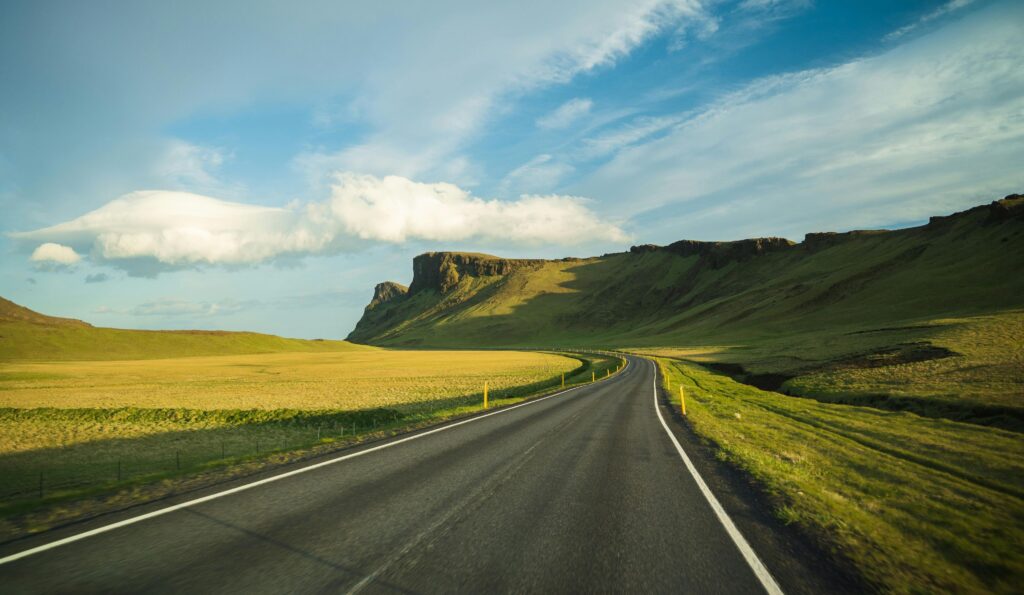
There are a few factors to take into account for each season in Iceland.
Summer Driving in Iceland
- You have 24-hour bright days, so you don’t have to worry about dark roads, but there are things that can still be hazardous
- On many roads outside of Reykjavík, you will find sheep roaming freely. It’s common for them to cross the road without warning. They have the right of way. The best advice is to slow down or even stop, if you see sheep/lamb close to the road. If a lamb is on one side of the road and the mother is on the other, just expect for it to cross to be with its mommy.
- Birds in Iceland seem to have death wish sometimes because they will actively fly in front of the car during the summer. I don’t understand why they do this. It often happens so quickly, that it can be hard to react. Just be aware that this can happen.
- Wind storms can happen during this season
- F-roads (highland roads) are open only during summer and they allow for you to explore an incredibly beautiful part of Iceland that few people ever visit.
Winter Driving in Iceland
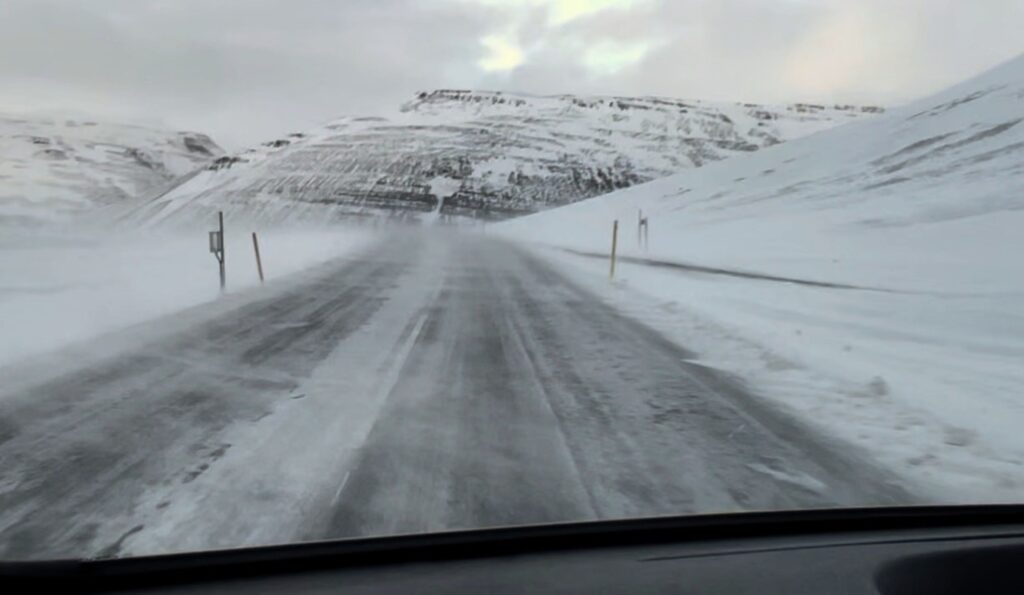
- Road conditions in Iceland during the winter can be a little challenging, especially if there it has been a particularly stormy season, and lots of ice and snow are on the ground.
- One big factor to consider for this season is the daylight hours. We have much shorter days in winter, which will impact the number of places you can visit in a day. I recommend using the link I provide that shows the daylight hours for each day in winter to plan your trip because it’s a bummer to try to cram a bunch of activities in a day only to find that the sun has set and you can’t see the attraction or place.
- Rental car companies put spiked tires on cares during the winter to help with traction on icy and snowy roads. This is very useful, but you still need to take caution when driving
- Snow and windstorms happen during this season. Sometimes, they are combined, which can cause extra trouble.
- People have gotten stuck on the road because of storms, so please take heed and check the weather advisories before heading out.
F-Roads vs. Gravel Roads: What’s the Difference?
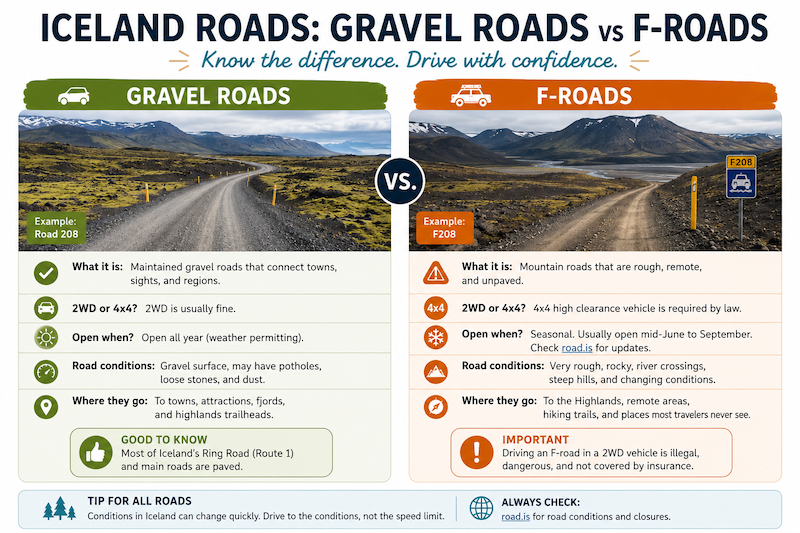
One of the biggest misconceptions I see from travelers planning a trip to Iceland is the belief that every gravel road requires a 4×4 vehicle. Thankfully, that’s not true.
Gravel roads are extremely common throughout Iceland, especially when you venture outside of Reykjavík and the Ring Road. Many scenic attractions, small villages, viewpoints, and even some popular tourist sites are accessed via gravel roads. In most cases, standard 2WD rental cars are perfectly capable of driving on these roads as long as conditions are good and you drive carefully. The main difference is that you’ll need to reduce your speed, watch for loose gravel, and allow extra stopping distance.
F-roads, however, are a completely different category of road.
The “F” stands for fjallvegur, which means mountain road in Icelandic. These roads lead into Iceland’s remote Highlands, a rugged interior region filled with volcanic landscapes, geothermal areas, colorful mountains, and vast wilderness. Unlike ordinary gravel roads, F-roads are often rough, uneven, and can include large potholes, steep sections, loose rocks, and even unbridged river crossings.
Because of these challenging conditions, Icelandic law prohibits driving on F-roads with a 2WD vehicle. A 4×4 vehicle is legally required, and rental companies will typically void insurance coverage if you take a non-approved vehicle onto an F-road. If damage occurs, you could be responsible for the full cost of repairs, which might mean replacing the vehicle.
A simple way to remember the difference is this: a gravel road is simply a road surface, while an F-road is a specific classification of mountain road. In other words, many gravel roads can be driven with a regular car, but every F-road requires a suitable 4×4 vehicle.
For example, the gravel road leading to attractions like Hvitserkur, many Westfjords viewpoints, or remote coastal areas can often be driven in a 2WD car. In contrast, routes such as F208 to Landmannalaugar, F35 (Kjölur), or F249 toward Þórsmörk require a 4×4 and may involve crossing rivers. F-roads are normally only open during summer (June – early September).
Before setting out, always check current road conditions on Road.is and confirm with your rental company whether your vehicle is approved for the specific roads you plan to drive. Doing so can save you from costly mistakes and ensure you’re renting the right vehicle for your Iceland adventure.
Planning to drive Iceland's F-roads?
Make sure you're booking an approved 4×4 for your route.
Very Important to Keep in Mind with Driving a Rental Car in Iceland
- Icelandic roads are often very narrow. Please do not stop on the road to take pictures or videos. Unfortunately, accidents have happened because of this behavior. It‘s best to find a safe place to pull over, if possible.
- The wind in Iceland can blow so hard that it can damage car doors when they are opened. One way to mitigate this is to hold onto the doors when opening them and not to open two doors at the same time. Basically, each person should turns getting out of the car on very wind days and make sure you are holding onto them. It‘s very expensive to fix a door damaged by the wind.
- Off-roading is illegal in Iceland and you will get heavily fined if you are caught.
- It‘s required that your headlights are always on here, even during summer when it is 24-hour bright days.
- There is no right turn on red anywhere in Iceland.
- The emergency number in Iceland is 112
7. Returning Your Car
- Make sure the tank is full or at the same level as how you received the car or you will be charged.
- Choosing the drop off location that makes sense for you.
- Sign off on the condition of the car at the company
Ways To Save Money When Renting a Car in Iceland
Due to my long term partnership with Go Car Rental Iceland and Go Campers, you can save money and get awesome extras when you rent with them via my link.
I actually use their cars and campers when I travel around Iceland, and I’ve partnered with them for over 4 years now. The main reasons? Their customer service is amazing, and they have a wide range of vehicles to choose from.
They’ve also given me a link so you can save 7% on your rental, plus get a couple of really useful extras.
Once you enter your travel dates, the 7% discount is automatically applied. In the extras section, you choose 4G Wi-Fi for Go Car and a sleeping bag for Go Campers,and it will be applied at no additional cost.
Ready to Book Your Rental for an Iceland Road Trip?
🚗 RENTAL CAR
Go Car Rental
7% off + Free 4G Wi-Fi
Click here to book
🚐 CAMPERVAN
Go Campers
7% off + Free Sleeping Bag
Click here to book
And just so you know, using my link gives me a small commission at no extra cost to you. It’s one of the ways you’re supporting All Things Iceland and the content I create. Thank you in advance for that.
Share this Post
Facebook
Email
Twitter
Let's Be Social
Þakka þér kærlega fyrir að hlusta og sjáumst fljótlega (Thank you for listening and see you soon.)