

Learning Icelandic can honestly feel overwhelming. If you’ve ever tried to learn the language, you probably already know that there are a lot of scattered resources online, different classes, private tutors, apps, YouTube videos, grammar books, and random websites that may or may not help depending on your learning style. One of the questions I get asked the most is how to actually learn Icelandic and what resources are worthwhile.
Why I Wanted to Try Icelandic AI
When I first heard about a program called Icelandic AI, I was really intrigued. Not because I thought it would magically make anyone fluent overnight, but because I was curious whether there was finally one platform that could bring many of these learning tools together in a more organized and comprehensive way.
Just for some context, I’ve been living in Iceland since 2016, so almost 10 years now. I’m at an intermediate level in Icelandic, and over the years I’ve taken multiple Icelandic classes, worked with private tutors, studied on my own, and I regularly speak Icelandic with my boyfriend and his family. So while I’m definitely not claiming to be fluent, I do feel like I have a good understanding of what makes a language-learning resource actually useful.
I also want to be transparent that I am collaborating with Icelandic AI in the sense that I reached out to them because I wanted access to the platform to test it out and share my thoughts with my audience. However, this is not a paid review, and I do not benefit financially if people sign up through the platform. I genuinely just wanted to see if this was a resource worth recommending because I know how difficult it can be to figure out where to even start with Icelandic.
First Impressions of the Icelandic AI Platform
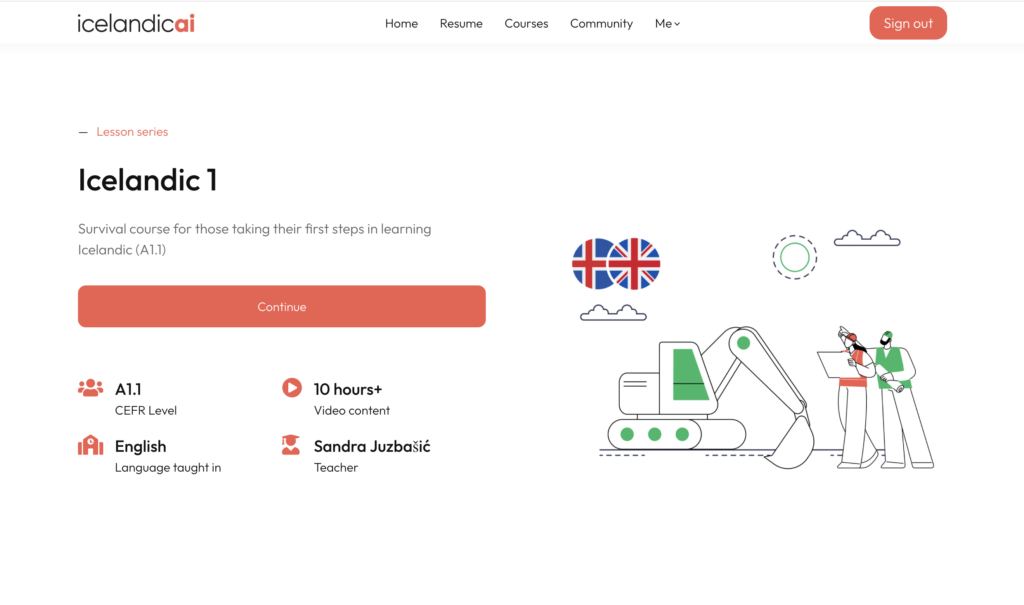
Overall, I have to say that Icelandic AI is one of the more comprehensive Icelandic-learning platforms I’ve seen so far.
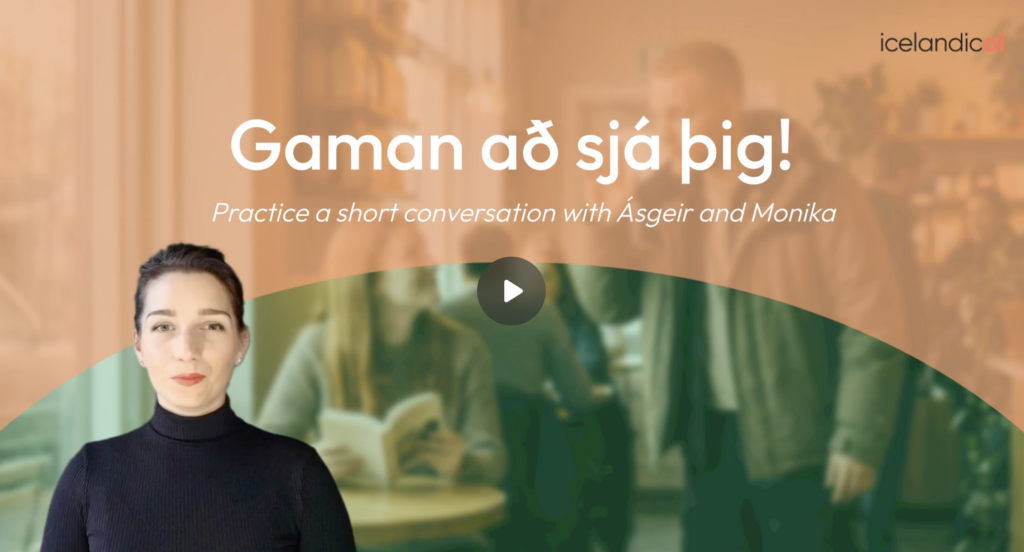
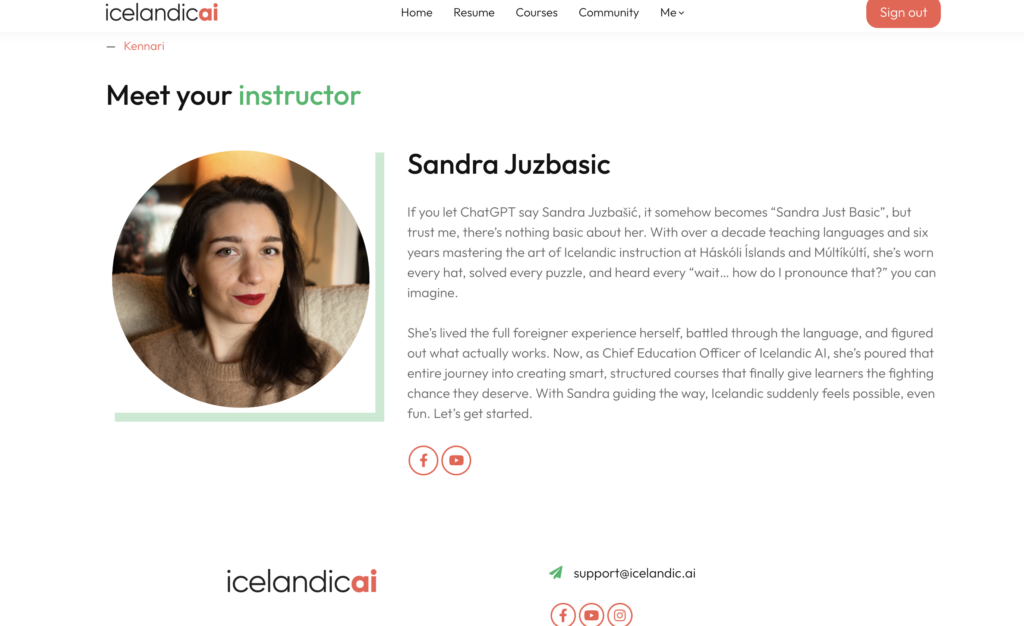
The platform was created by Sandra, and the “AI” part of the name is actually referring to her AI twin or clone. So instead of it being like ChatGPT or Claude where the AI is actively learning you and responding dynamically, it’s more that Sandra has created an AI version of herself that guides you through the lessons using her voice and likeness. There are also additional AI characters named Monica and Oscar who help throughout the platform as well.
At the time of recording this episode, I’ve completed about 55% of Level 1, which has already taken me around 49 hours, and I’ve also started Level 2. Even as someone who already has background knowledge in Icelandic, I’ve still found it useful as a review tool and as a way to reinforce concepts I’ve already learned.
One thing I also appreciate is that the platform doesn’t feel rushed or surface level. There’s a lot of depth built into it, and you can tell that a huge amount of work went into organizing the information in a structured way. It’s not just random vocabulary words thrown at you. There’s an actual progression to how concepts are introduced and built upon over time.
Now let’s get into the pros and cons.
The Pros of the Icelandic AI Learning Platform
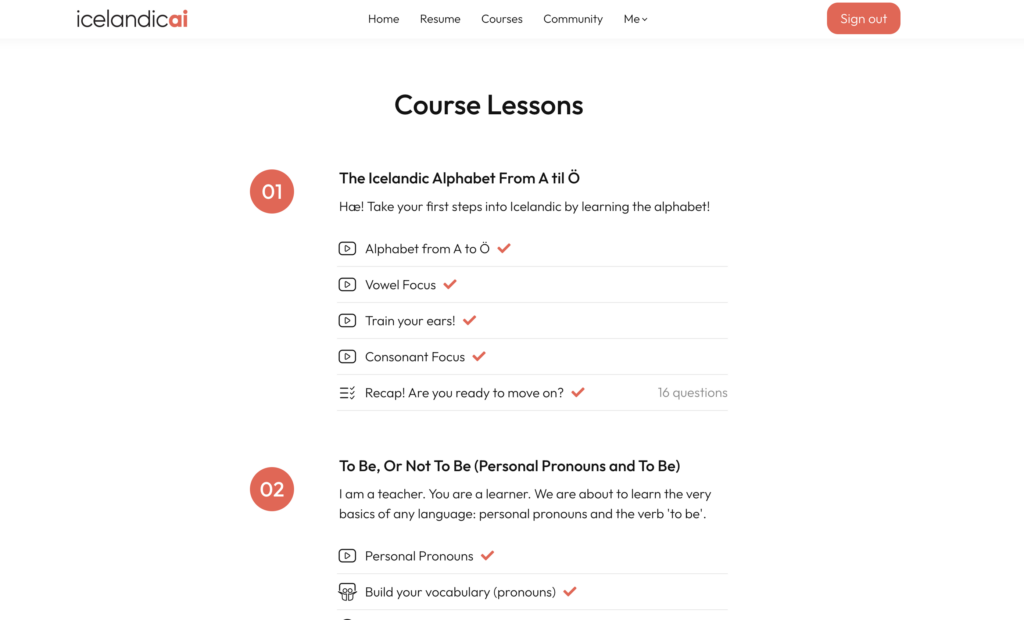
1. The platform is extremely comprehensive
All of the core things you need to learn Icelandic are included: grammar, conjugation, sentence structure, pronunciation, vocabulary, and the four Icelandic cases. There is a lot of depth to the lessons.
2. It’s easy to access and flexible
You can work through the lessons on your own time and from anywhere. Right now it works best on a computer, but they mentioned they are working on a mobile-friendly version as well.
3. It can potentially be reimbursed through Icelandic unions
If you live and work in Iceland and are part of a union, there’s a possibility you can use your educational reimbursement funds toward the course because it has educational certification.
4. There’s a community section
The platform has a community tab where you can ask questions and interact with the Icelandic AI team, which is helpful when you need clarification.
5. There are pronunciation checks
You can record yourself speaking into your microphone and the platform gives feedback in the form of a percentage score from 0–100 based on pronunciation accuracy. I actually found this surprisingly useful.
6. The platform is visually engaging
The lessons are interactive, visually appealing, and easy to follow. There are a lot of graphics and clickable elements that make it feel more engaging than just staring at blocks of text.
7. The lessons are well organized
The progression makes sense. You start with greetings and introductions, then move into present tense and foundational concepts before building into more advanced grammar and sentence structure.
8. There is a huge amount of material
Honestly, there is a lot in here. It can feel a little overwhelming at first, but in a good way. You’re definitely not going to run out of things to study anytime soon.
9. There are quizzes and flashcards
The platform includes quizzes, review sections, and flashcards to help reinforce what you’ve learned.
10. You receive a certificate of completion
At the end of the levels, you receive a certificate showing you completed the coursework, which is a nice touch.
One thing I kept thinking while going through the lessons was that I really wish something like this had existed when I first started learning Icelandic years ago. Back then, I felt like I was constantly piecing together resources from all over the internet. This feels much more centralized and organized, which can make a huge difference for beginners who don’t even know where to start.
The Cons of the Icelandic AI Learning Platform
1. It’s not conversational AI
This is probably the most important thing to understand going into the platform. The AI is not actively talking back and forth with you the way ChatGPT or Claude would. Sandra’s AI twin guides you through lessons, but it’s not a live conversational experience.
2. You still need conversation practice outside the platform
If your goal is becoming conversational, you’ll still need to practice speaking with real people outside of Icelandic AI, whether that’s friends, tutors, classmates, or language exchange partners.
3. The pronunciation feedback could be improved
While the pronunciation checker is helpful, I do wish it played back your voice or directly compared your pronunciation to a native speaker’s recording. I think that would make the feedback even more useful.
4. You need to be self-motivated
Because this is self-paced, it requires discipline. Unlike in-person classes where there’s accountability and scheduled meetings, you have to consistently show up for yourself and stay committed.
5. Advanced learners may need to wait for more content
Right now the platform includes Levels 1 through 3, and I’ve heard more levels are coming. But if you’re already intermediate or advanced, you may move through the current material fairly quickly and have to wait for additional content.
My Overall Thoughts
I’ve genuinely enjoyed using Icelandic AI, and I plan to continue going through the lessons because I think it’s a really valuable review tool even at my current level.
At the same time, I still don’t believe there’s one perfect resource that can fully teach you Icelandic on its own. I think learning this language usually requires a combination of resources, consistency, practice, and patience. But as far as comprehensive platforms go, Icelandic AI is definitely one of the better ones I’ve personally seen.
I also think it’s important to remember that learning Icelandic is a long-term process. This is not an “I studied for two weeks and now I’m fluent” type of language. It takes repetition, exposure, practice, and patience. So having a resource that keeps everything organized and accessible in one place can genuinely be really helpful.
If you want to check it out for yourself, here is the link to Icelandic AI. As always, it’s completely up to you, but hopefully hearing my experience gives you a better idea of whether it might fit your learning style and goals.
Random Fact of the Episode
One random fact about the Icelandic language is that Icelandic has changed so little over time that modern Icelanders can still read the medieval Icelandic sagas written hundreds of years ago with relatively little difficulty.
Compared to English, which has changed dramatically over the centuries, Icelandic has remained incredibly well preserved, which is one of the reasons why the language is both fascinating and challenging to learn.
Icelandic Word of the Episode
The Icelandic word of the episode is “Æfa sig”, which means “to practice.”
And honestly, I think that’s one of the biggest lessons when it comes to learning Icelandic. There’s no perfect app, no perfect teacher, and no perfect method. A lot of it really comes down to consistently practicing, even when the language feels difficult or awkward.
Share this with a Friend
Pinterest
Facebook
Email
Let's Be Social
Þakka þér kærlega fyrir að hlusta og sjáumst fljótlega.